What changed for EIS, SEIS and VCTs, how the three compare, and what the risks are
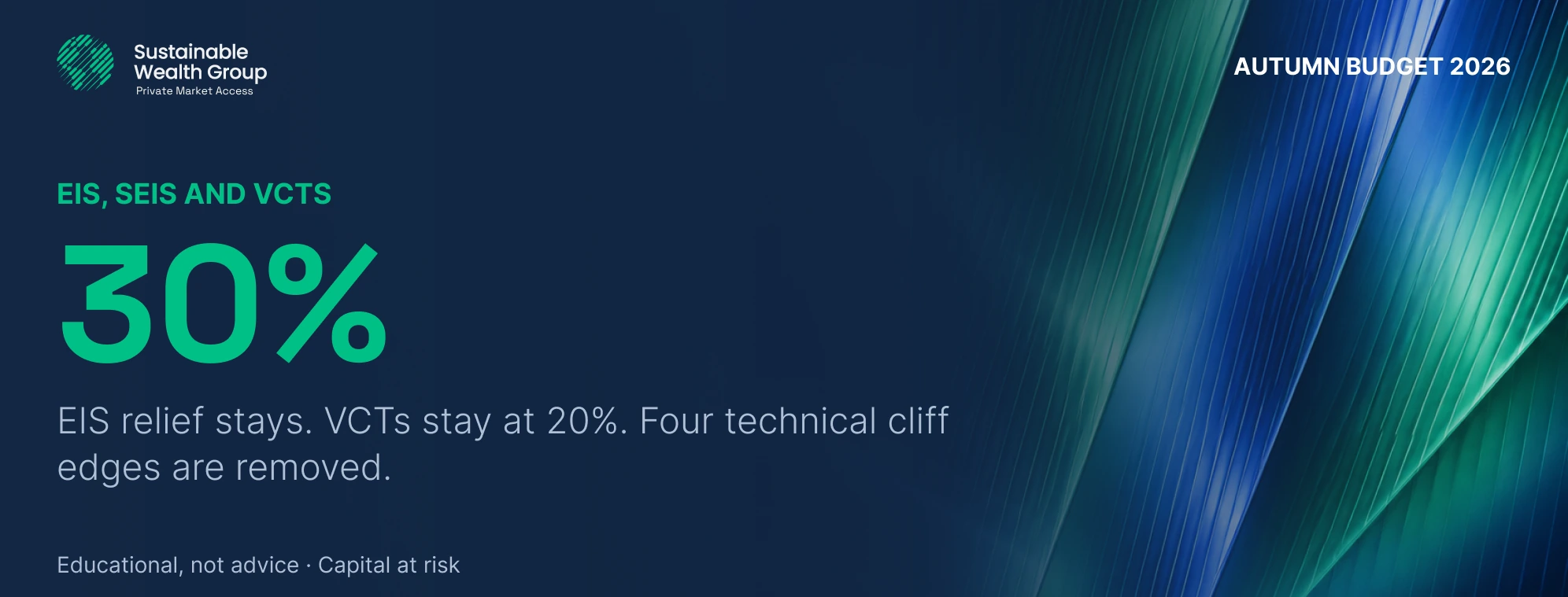
The Autumn Budget 2026 left EIS income tax relief at 30% and SEIS at 50%. VCT relief stays at 20%, where it was cut from 30% in April 2026. From 6 April 2027, the Budget also removes four technical problems that have cost investors their relief in the past.
These are high-risk investments in small private companies. Relief softens the outcome of a bad investment, and it does not make a bad company a good one. Selection still decides the outcome.
What are the four changes?
- Limits breached: where a company goes over its annual or lifetime investment limit, relief survives on the portion of the round within the limit. It is no longer all or nothing.
- Same-day investment: SEIS and EIS or VCT money can be invested on the same day without affecting eligibility.
- One investor's failure: if one investor fails the fully-paid-up requirement, the others in the same issue keep their relief.
- Late money: HMRC gains discretion where subscription money arrives late for exceptional reasons outside anyone's control.
The Budget also aligns SEIS interest rules with EIS, sets VCT clawback at the rate in force when shares were issued, and commits the Treasury to work on fund transparency and fees, and on faster advance assurance.
Get the Autumn Budget 2026 investor guide
Every measure in pounds and dates, with a checklist of questions to take to your adviser before 5 April 2027.
How do SEIS, EIS and VCTs compare?
SEIS
- Income tax relief: 50%, on up to £200,000 a year
- Capital gains: nil on exit after 3 years, with 50% reinvestment relief
- Loss relief against income: yes
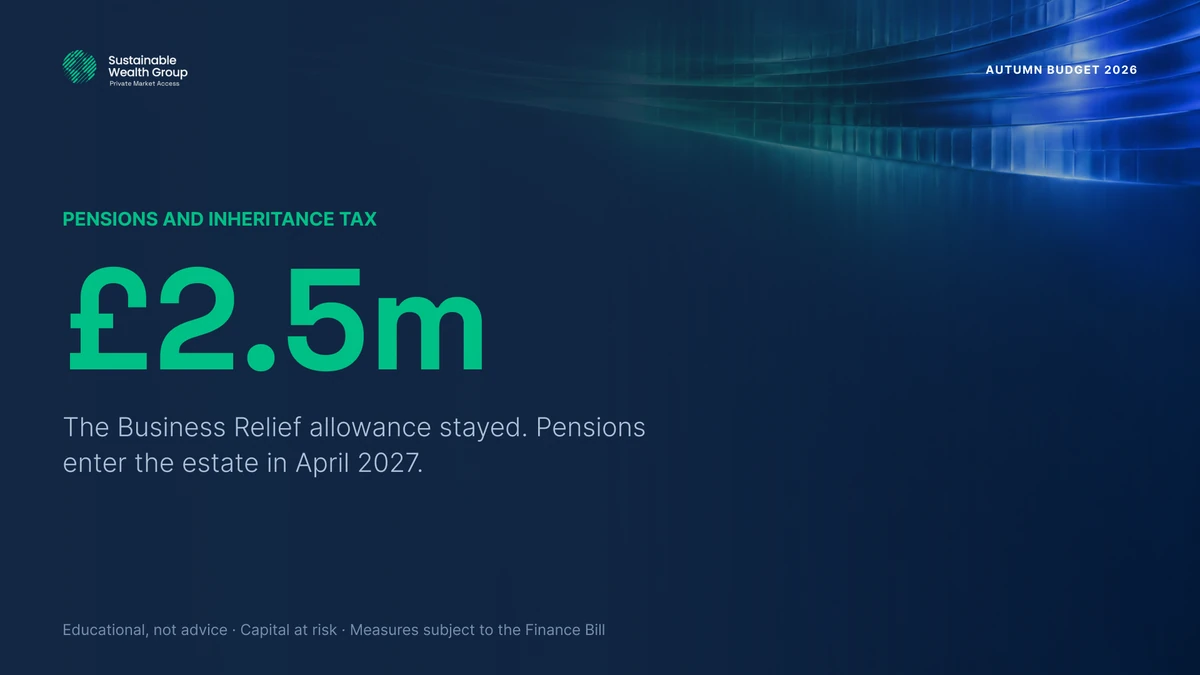
- Inheritance tax relief after 2 years: yes, within the £2.5m allowance
- Carry back to the prior tax year: yes
EIS
- Income tax relief: 30%, on up to £1m a year, or £2m if at least £1m goes into knowledge-intensive companies
- Capital gains: nil on exit after 3 years, with unlimited deferral
- Loss relief against income: yes
- Inheritance tax relief after 2 years: yes, within the £2.5m allowance
- Carry back to the prior tax year: yes
VCT
- Income tax relief: 20%, on up to £200,000 a year
- Capital gains: nil on exit after 5 years, with no deferral
- Loss relief against income: no
- Inheritance tax relief: no
- Carry back to the prior tax year: no
A VCT holds a spread of companies inside one investment, which direct EIS does not. An EIS investor has to build that spread personally.
How does the relief work on £100,000?
Take £100,000 invested in an EIS-qualifying company, assuming full qualification.
- Net cost: 30% relief returns £30,000, so the real cost is £70,000
- If the company fails, higher-rate taxpayer: loss relief returns £28,000, for a net loss of £42,000
- If the company fails, additional-rate taxpayer: loss relief returns £31,500, for a net loss of £38,500
- If the company doubles: the £100,000 gain is free of capital gains tax after three years
What are the risks?
- Any single company may fail entirely, and you can lose your whole investment in it.
- Shares are typically illiquid for three to seven years, and usually pay no dividends.
- Relief depends on the company and the investor meeting and maintaining qualifying conditions, and can be withdrawn.
- Experienced investors spread across eight to twelve companies over several tax years, which requires capital they can afford to tie up.
Private-company investing carries materially higher risk than cash, property or pensions. For many people, the right answer is to stay in an ISA and a pension.
FAQ
Did the Autumn Budget 2026 change EIS relief?
No. EIS income tax relief stays at 30% and SEIS at 50%. The changes are technical and apply from 6 April 2027.
What are the company limits?
From April 2026 they doubled to £10m a year, £24m lifetime and £30m of gross assets, with higher limits for knowledge-intensive companies.
Can EIS relief be carried back?
Yes. EIS and SEIS relief can be carried back to the previous tax year.
Who can see private-company opportunities?
Introductions from Sustainable Wealth Group are made only to investors who self-certify as high net worth or sophisticated under the Financial Promotion Order.
Related reading
- Autumn Budget 2026 for Investors: Cash and Property Income Taxed Harder, Building Companies Rewarded
Get the full guide
The guide compares EIS, SEIS and VCTs in full, and sets them against the other Budget measures with the risks stated. Download the free Autumn Budget 2026 investor guide.
Sustainable Wealth Group introduces qualifying investors to private companies. It does not advise investors or carry out due diligence on their behalf.
Sources: HM Treasury, Autumn Budget 2026, venture capital schemes measures (28 October 2026); Hazlewoods (28 October 2026); HMRC, Tax relief for investors using venture capital schemes; Finance Act 2026.
Capital at risk. EIS, SEIS and unquoted investments are high risk and illiquid, and may lose all of their value. This article is for information and education only. It is not financial, tax, legal or investment advice, or an offer or solicitation to invest. Measures announced on 28 October 2026 are proposals subject to enactment in a Finance Bill and may change. Tax treatment depends on individual circumstances and may change. Worked examples are illustrative. Seek independent advice before acting.
Get the Autumn Budget 2026 investor guide
Every measure in pounds and dates, with a checklist of questions to take to your adviser before 5 April 2027.